
The above video is from the October 2nd, 2026 Opening Reception for Eric Serritella's "Sharing Spaces" here at Gravers Lane Gallery. The article below is from Rachael's sit -down interview with the artist, which is mentioned in the video above.
For Eric Seritella, it all started with a dream: He wanted to be a rockstar.
But when his high school band quietly shut off his microphone during rehearsal, he realized his teenage dream of rocking with Led Zeppelin on stage at Madison Square Garden was no longer in the cards.
After shifting gears and receiving a Bachelor’s in Communications, Eric dove into the corporate world, beginning a career in Marketing and Advertising. Up until his mid-thirties, being a trompe l’œil artist wasn’t the plan. However, that all changed when he decided to take a pottery class.
Our conversation started with Eric explaining how he transitioned from a corporate career to a career in contemporary craft. While seated in the garden area behind the gallery in late July, I (Rachael Forbes) was joined by Gravers Lane’s own Mia Chen as we chatted with Eric about his early career, nature motifs, and the cultural influences in his work.
“When you were younger, did you envision, at this point in your life, that this is where you would be?” I asked the artist. He chuckled.
“Um, ya know, I really didn’t know. I was a liberal arts major; I have a degree in communications. Even when I graduated college, I didn’t know what I wanted to do. The truth is that I wanted to be a rockstar. I played in a high school band, and the funny story is, I was singing backup, and when I wasn’t looking, they turned my microphone off.” We both erupted in laughter.
“I thought, ‘I guess I am not going to Madison Square Garden’… So I just figured I would go into the business world. I grew up in an IBM neighborhood. I went to college and started with a business plan, but switched to communications, and you know, I went into the corporate world… It was never the plan (being an artist).”
“In my thirties, I fell in love with clay… I took a pottery class, and I started to do some street fairs to kind of make it a hobby that paid for itself. I bought a wheel and a kiln… and so, (after some time) I decided to leave the corporate world after about 16 years in it… I knew I didn’t have another 10 years in me… I could see the burnout coming. So, I gave 6 months’ notice and left on a high note, and started doing street fairs… In 2003, I met a Taiwanese artist named Ah Leon… we became friends. The night before he went to go back to Taiwan, I said, ‘Ah Leon, what’s next for me as an artist?’ and he said, ‘Eric, you need to make better pots.’ And so, that was how I ended up going to Taiwan and doing residencies there, and that’s how I made up for not going to art school.”
Eric’s unexpected journey was fascinating to me. For an artist to be so renowned, but never expect to become an artist in the first place, was a wonderful example of just how life has a way of throwing curveballs at you. Of how the butterfly effect shapes everything on our paths as they twist and turn, much like the branches and root systems of birch trees.
“Even as it was happening, even when I was a full-time potter, I didn’t think that was the plan. It was only at the point that I started doing the work that I do now that I thought, yeah, now I’m an artist.”
“This is so interesting,” I stated. “The twists and turns of life, you never really know where you are going to go. To hear where you started vs. where you are now is such an unexpected journey. I couldn’t have begun to piece it together, which is so exciting. Your work now is starting to change; you’re going through another twist and turn. So, with that being said,
“Do you mind explaining where this change is coming from, and where you hope to go with that?” I prompted.
Eric sucked in a breath. “Well, when the pandemic came along, it kind of coincided with the work maturing. It was hitting that peak, and when the pandemic came, and it was clear that things were not going back to normal, I was pretty much unemployed. I was on the board of directors for an art center, and it turns out that the center had a full glass hot shop and a clay studio. I raised my hand, and I offered to be the resident artist, to live there for a couple of months. So, that’s how it started. I went in with no agenda, no preconceived notion. My goal was to kind of combine clay and glass, but I didn’t quite know how. I ended up being at the center for a year, and when I came out of that, I had one really nice clay and glass piece. I entered it into a solo show here in Raleigh, and I thought, man, I might really be onto something.” Eric explained.
“I am always going to make birch trees. You know, Elton John, he’s always going to play Rocket Man. The man is 79 years old and still plays Rocket Man. I am no Elton John, but I’ll always make birch trees…” The three of us shared a laugh.
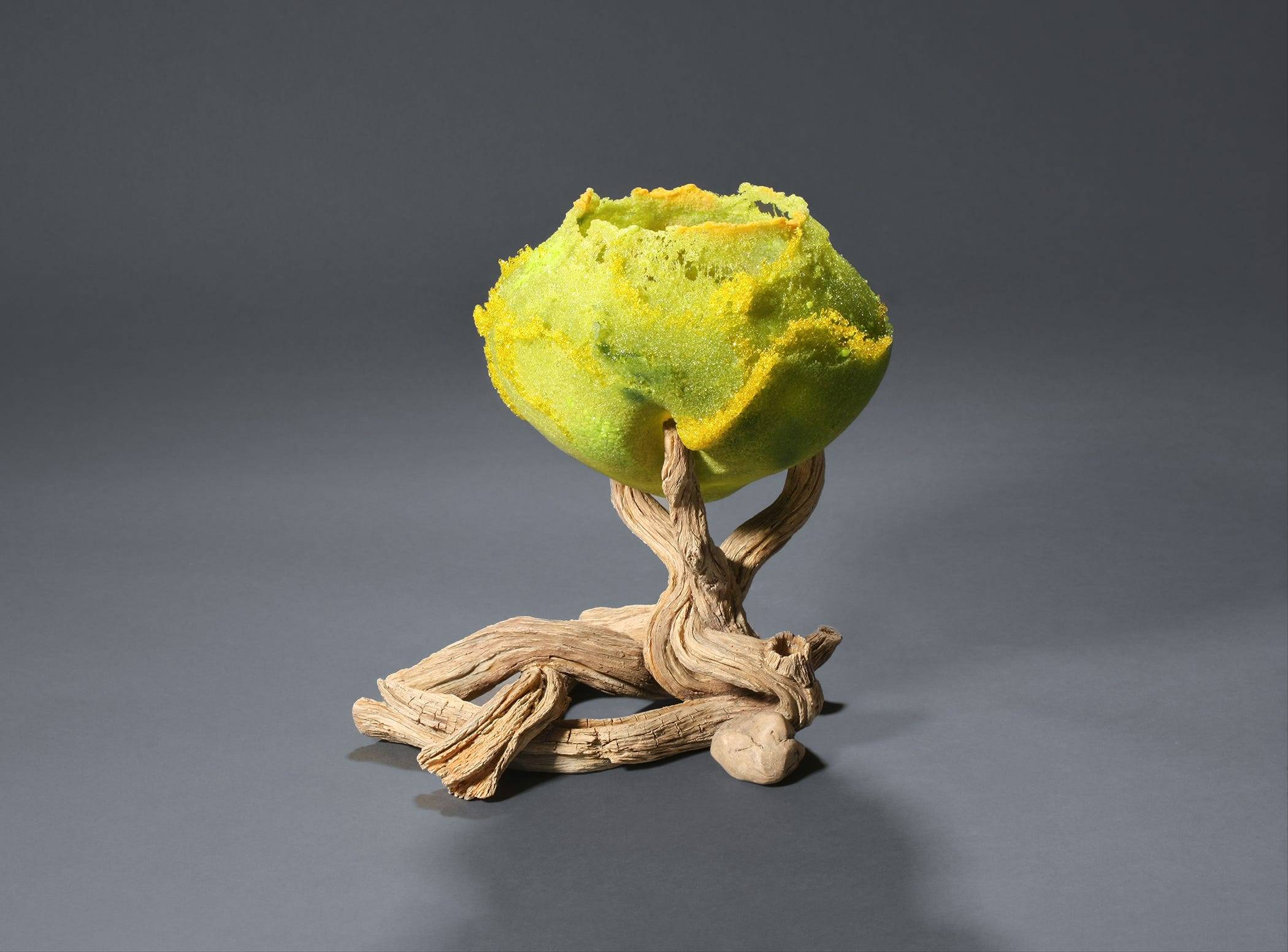
“The glass brings in this new artistic alter ego. Clay is very limited in palette… Glass is transparent and shiny and bright and comes in so many colors. I started abstractly in glass. And then I kind of combined the two, but the goal wasn’t to combine the glass with trompe l’œil. But it ended up creating this really wonderful visual tension between the different characteristics of the medium, realism, and the abstract in the same piece.”
A great example of what Eric is describing above can be found in his piece titled Adrift III, seen below.
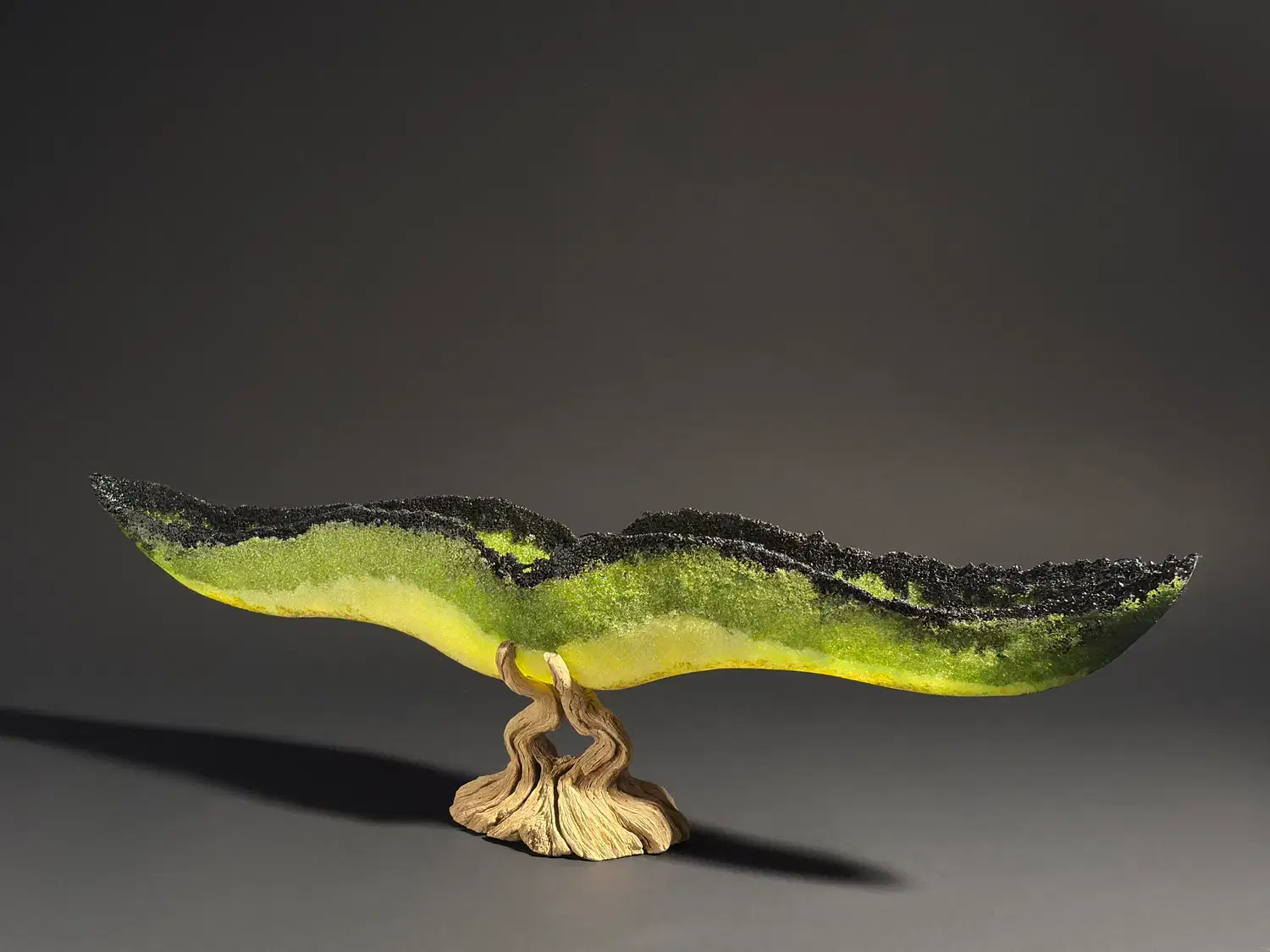
”I find a lot of excitement in playing with color and color palettes, and finding a way for the two different materials to work together and create positive visual tensions. I love the spontaneity in the glass process… I am pushing the glass process to the edge. I am creating that wabi-sabi, that beauty of imperfection. I want my glass to be cracked, dripping. I use a process called pate de verre, which is a glass powder… I now know how to fire the kiln to get the glass to distress, but I don’t know where that distress is going to be.”
“That unknown that the glass brings is pretty exciting. It brings back (the excitement) that opening up the potter’s kiln brought in the beginning. The two materials don’t always work together, but when it does, it is really rewarding. I am very hard on myself, which is tough, but I am willing, when it is good, to revel in the piece.” Eric rounded out.
“I enjoy the bit of expectation along with the added element of not knowing where it is going to go-” I started
“It’s very rock and roll!” Mia exclaimed, drawing a smile from the three of us.
“Yeah! You know, there is such a comfort zone in the clay work. I find that I am simultaneously mindful and oblivious to every detail. That’s a very peaceful place to be.” Serritella agreed.
“You say that you have very high expectations for yourself. So, what would you say is one of the most valuable lessons that your practice has taught you?” I offered as a segue.
“Oh, that the beauty and the growth are in the mistakes.” He answered. The statement was spoken quickly, almost as a matter of fact, like these were the words that the artist lived by.
“If not mistakes, then things not going right. The kiln not firing correctly, or the way that I came across distressed glass by overfiring the kiln. The piece wasn’t what I was expecting, and at first, I was cursing myself, but then my second reaction was, ‘Oh my god, what have I found?”
“To bring it back to rock and roll, the Grateful Dead has a song where they say, ‘Once in a while you get shown the light in the strangest of places when you look at it right.’
It’s about seeing the opportunity in failure.” The artist explained.
“I’m not sure that you can learn, or learn strongly, without making a mistake.” I offered in agreement. Eric’s take on the opportunity that lies within failure was incredibly refreshing. It made me ponder how much of the wisdom that I have acquired has been earned through, or due to, failure…
Following this topic, we transitioned towards the experience of the viewer as they perceive Eric’s trompe l’œil ceramic pieces. After mentioning the jaw-dropping experience of revealing to the viewer that some of Serritella’s work is functional (i.e., teapots), Mia took the conversation from there.
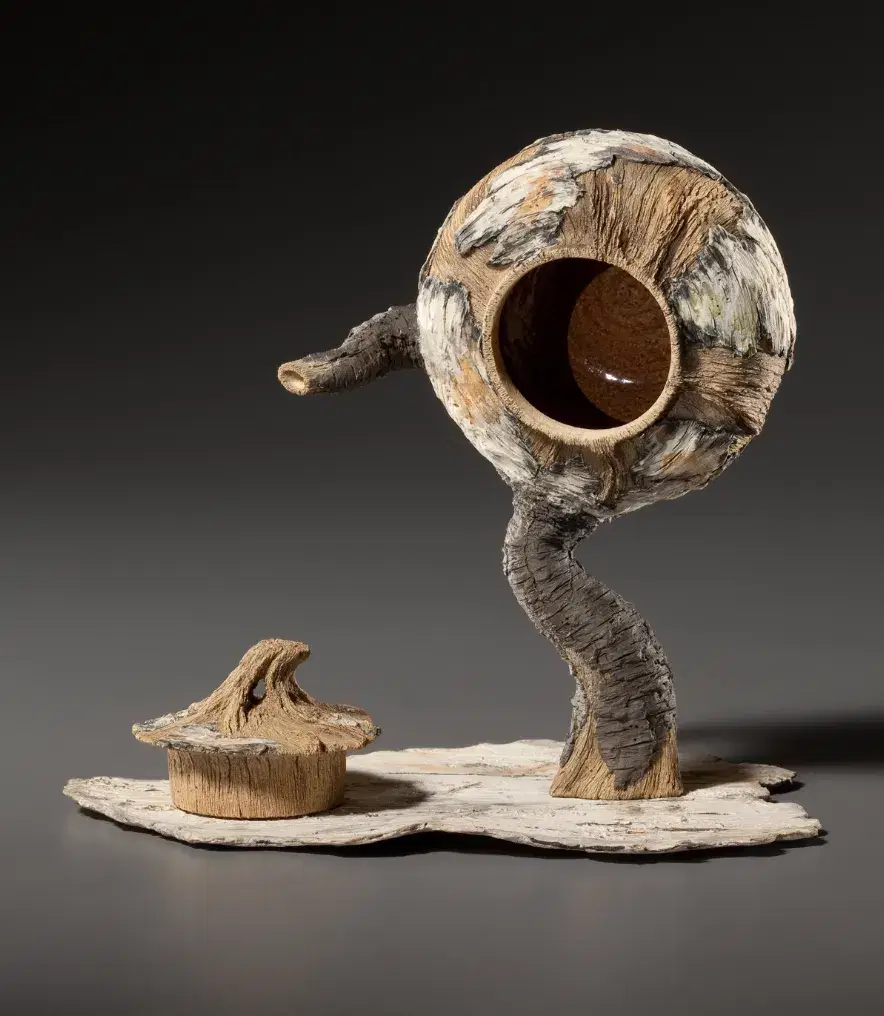
“I am hearing this, and I am drawing parallels to other things you have mentioned, but especially the tea. The gong-fu tea brewing method- you know, gong-fu means to train or to cultivate one’s skills. I have always wondered, or pondered, what that meant. But to me, it means to appreciate, to observe, to learn. To understand everything that a tea can be. And then, learning how everything you do can affect that process, and gradually understanding it more. You can figure out what you want to do with it, and then you can start bending it to do what you want… I can see a lot of that in your work. You learned how you can do it perfectly so that you can do it imperfectly, in some ways. A lot of your work is done with an emphasis on the imperfections.” Mia mused.
“Exactly. You nailed it!” Eric exclaimed.
“To reflect on what you (Mia) said, that is a part of gong-fu. Learning everything about the tea that you can. All of these things, the brew temperature and whatnot, affect the tea. Gong-Fu tea means to brew it with great care. This particular tea method is similar to a wine tasting. Your goal, as a gong-fu tea master, is to create a mood and environment where you, as the host, are in a state of wuwei, which means ‘doing without doing.’ In your brewing, you’re sort of doing it without really doing it… That’s wuwei, and yes, that’s the way that I work now. It’s an almost Zen-like spirituality that I bring into the work.”
“And then that imperfection, which is the wabi-sabi philosophy, which comes out of the Japanese tea ceremony. In the 1600’s, Sen no Rikyū was the tea master to the emperor. At the time, Japan was importing a lot of high-end Chinese porcelain. It was for the rich, but he wanted to make it more accessible to local people. He started hiring local potters to make more modest tea wares. This is where raku comes from… It’s imperfect because it’s fired in a wood kiln by local potters, with the pitting and varying temperatures. All of that- it’s where wabi-sabi comes from, the beauty of imperfection… Nature is amazing even in its degradation.” Eric explained. I nodded my head in contemplation.
“To round us out… do you have something that you would like to say to younger Eric who is just getting started in all of this?” I prompted with a smile.
“Oh god,” Eric began. Which is exactly how I’d hope his answer would start.
“You have to be willing to take the risks. Find the growth, see the light, find the opportunity; be an opportunist. Which, I know, is a loaded word. I think as an artist, you have to be an opportunist by finding the opportunity everywhere you can. Take risks and follow through. It’s interesting when I look back…”
“You know what, now that we’re in a therapy session, I’m gonna lie down.” Eric joked. I cannot lie, Eric’s willingness to be candid and to have fun during our conversation brought me joy. I could imagine him lying on a chaise, hands folded across his chest, as he gazed up at the ceiling and reflected back on his life. I couldn’t help but laugh maniacally internally at the existentialism that I prompted the artist to explore with us that day.
“This creativity was in me my whole life, ever since my childhood. I just didn’t know it.” Serritella answered.
Our conversation drew to a close as the noise of Chestnut Hill reached a roar. With a smile and a laugh, the three of us signed off, thanking Eric not only for his time, but for the lessons he taught us. Serritella’s artistic practice draws from both nature and rock and roll. Carrying himself with the poise and grace of birch trees, Eric’s approach is very, for lack of a better way to put it, rock and roll.
Though he may not be playing to crowds in Madison Square Garden, Serritella’s work reaches audiences far and wide. With pieces showcased in The Smithsonian American Art Museum, The Metropolitan Museum of Art, the Carnegie Museum of Art, and many more, Gravers Lane Gallery is proud to showcase the work of renowned artist Eric Serritella. Select works are also available for purchase on our website.
Thank you, Eric, for the opportunity for us to sit down with you. It was such a pleasure.
- Rachael Forbes, Gallery Associate at Gravers Lane Gallery